Showing posts with label global food security. Show all posts

Sunday, 3 January 2016

The Role of Climate, Conflicts and Economies on Future Food Security

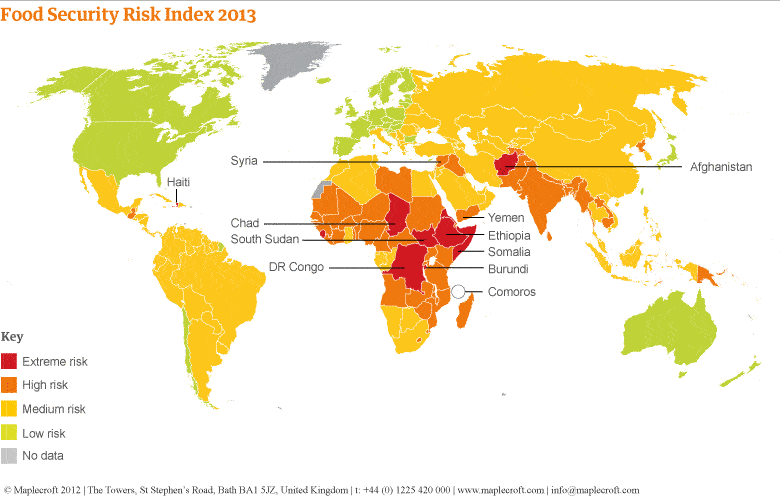
Source: The Guardian

Climate change is undoubtedly one of the most pressing issues of our time, and will continue to worsen if our attitudes fail to change quickly. As discussed in a previous post, food insecurity is amongst our greatest concerns when it comes to climate change, with the potential to leave millions in food poverty and increased deaths. Some models predict that we have the capacity to produce enough food for the global population over the next 20 to 30 years, while others contest these claims, stating that climatic variations may see a net decline in major cereals, such as corn, wheat and rice, over the next 20 years. Despite this, multiple studies agree that our ability to expand production is slowly diminishing, as intensification and exploitation of resources reach their limits.

Diverse regions across the world face variable levels of food systems vulnerability due to the different physical, social and economic abilities to cope with climate change. Alongside the direct causes, like change in weather patterns, many indirect also causes play havoc with the future of global food security, such as disease, poverty and politics.

On the contrary, it’s not all bad news for everybody over the globe, as some areas may soon start to enjoy social and economic growth as a result of climate change…


Climatic Impact on Food Security

Source: http://i.imgur.com
With increasing global temperatures brings great changes in regional climates and weather patterns. Take, for example, the high temperatures and increased precipitation we have experienced this winter, leading to mass flooding and social devastation. In terms of food production, tropical and subtropical regions are highly in danger of decreased food security due to a rising risk of drought. It is estimated that many countries across these regions could receive less than the minimum 120 days necessary to produce sufficient cereal crop yields, plunging already typically vulnerable countries into economic decline. The increasing occurrence of El-Niño Southern Oscillation (ENSO) events are thought to be related to enhanced dry spells, particularly in sub-Saharan Africa. This implies that this region is likely to be the most at risk of hunger and food insecurity in upcoming years. Additionally, with heightened chance of drought, decreased precipitation and increased evaporation comes greater risk of water scarcity, which is forecasted to affect 5 billion people by 2025.

Although, these projections are largely based upon models and assumptions, which do not take into consideration the likelihood of technological development, adaptation strategies, international support, and political attitudes to climate change, which may see some of these regions less affected than predicted.

Interestingly, a majority of countries located in the temperate and arctic climates (mainly in the northern hemisphere) will experience an approximate 9% gain in arable land suitable for agriculture. This expansion will mainly be observed across Russia, North America, Central Asia and northern Europe, seeing respective boosts in local economies and availability of food. Despite this, it is postulated that, on the global scale, food reserves will remain relatively the same. So, this does not solve the distribution problem effectively! Additionally, this prediction of increased agricultural land in these regions does not take heavily into account the potential for unprecedented occurrences to take place, such as natural hazards, flooding/waterlogging, conflict or political instability.

Other Impacts on Food Security

However, as discussed above, climate is not a single deterministic factor of food security. Although it is the most quoted, many countries, such as Least Developed Countries (LDCs), struggle to cope with sudden shocks and variations due to a lack of infrastructure, financing, skilled labourers, and much more. The resulting issue tends to increase with heightened instability of external factors, instead of just climate change itself. For example, despite Europe, USA and eastern Australia having an incredibly high human threat to water security due to severe drought, climatic variations and detrimental agricultural practices, their ability to cope is high, as they are technologically and economically equipped to manage. (This demonstrated in the image below).

Poverty is the most obvious aggravating factor, as it can lead to reduced technological capability, poor social infrastructure (housing, transport, etc.) and increased risk of disease. With food security reliant upon availability, access and utilisation, these characteristics are highly pertinent. To illustrate, lack of efficient transportation reduces access to food from outside regions (which is particularly concerning in the face of an environmental or social emergency), lack of trained agriculturalists or labourers impacts the quality and availability of food, and lack of economic security increases hunger and food poverty. Additionally, approximately half of all malnutrition is caused by non-food related aspects, such as HIV/AIDs and malaria, which are amplified by increasing global temperatures, and are often located in LDCs. That really is the icing on top of a shit-filled cake…

To add insult to injury, political alliances also have a huge part to play in the battle for food security. Alliances with countries who are well-equipped to deal with climate change, such as North America, Europe and Australia, may be ensured aid, safety and refuge in potentially dark times head, whereas less-economically developed countries may find themselves marginalised and left to fend for themselves (despite statistically contributing a whole lot LESS to global warming). Additionally, these political alliances can become vastly unpredictable, particularly during the current “war on terror”, born almost immediately after the 9/11 attacks in 2001, which continues to deconstruct and rebuild new political affiliations on a regular basis.
____________________________________________________________________________________________

AHHH! The voice is my head is almost screaming as I write… Which factors do you see as the most damaging to future food security? Climate change? Economic stability? Political stability? Health? Something completely different? Or a mixture of certain factors? Let me know in the comments!


Wednesday, 23 December 2015

Dietary Decisions: Part 2 - Lettuce is Worse Than Bacon!?

Source: www.cohabitaire.com
I cannot lie, and say that I haven’t found writing this post incredibly difficult! First of all, reaching a scientific consensus was a bit of a challenge, with many conflicting opinions and interests on the issue, and many studies only focusing on certain impacts (direct emissions, land-use, etc.). You begin to wonder who you can really trust. Despite this, after many days of research, I finally felt that I had reached a solid understanding of the literature and concluded that plant-based diets are the clear winners when it comes to the environment (as is often echoed). "Yay!", I thought, now I can commence the writing process... However, literally minutes before my fingers hit the keyboard, I come across this article boldly claiming “Lettuce is ‘three times worse than bacon’ for emissions and vegetarian diets could be bad for the environment”. Sensationalist to the max, I know, but I couldn’t help getting caught up in the drama and feeling like my many hours of research were nothing but a complete waste of time and effort. Luckily, I manage to trundle through the article and associated research paper, and deduce that the conclusion was based upon dietary recommendations, not vegetarian diets, and that it was totally twisted out of context. Not to mention that lettuce is very water and carbon intensive as vegetables go. So, finally, I manage to regain my confidence and comprehension.. And then, BAM! I realise that, although I don’t eat a great deal of meat, sometimes I really love beef burgers, cheese and bacon, and I start to feel the need to totally reassess my life and values…

But, fear not! All hope is not lost for the meat enthusiasts… If you dare to read further, you may find some surprising (and some not so surprising) results.

An Emissions-Based Approach

The most common measure of climate impact within the food industry is the amount of direct greenhouse gas emissions produced, equivalent to the mass of CO2. This excludes any emissions produced by land use, deforestation, transportation, cooking, storage, etc.

My research began through the investigation of five American diets – Meat Lover, Average, No Beef, Vegetarian, and Vegan – compiled by the USDA’s Economic Research Service and adapted by Shrink That Footprint, inferring a consumption of approximately 2,600kcal per day.

Unsurprisingly, the results showed that GHG emissions escalated with increased meat consumption, with vegans at the low end of the scale, and meat lovers at the other. Interestingly, vegetarianism did not fall too short behind veganism, despite the vast proportion of animal products consumed by vegetarians coming from dairy cows – which are shown here (and in my previous blog post) to contribute massively to potent greenhouse gas emissions. An even more surprising finding is that simply omitting red meat from the diet has a drastic reduction in carbon footprint, and contributes to a similar measure of emissions compared to vegetarianism. It seems maybe we should consider ending our romanticism with beef and lamb, and rediscover our love for white meats (or none at all). The research concluded that, in the average American diet, 60% of emissions were produced by meat and dairy, although only equating to 25% of the energy in the diet.
Comparing emissions of consumed food
Source: Shrink That Footprint


However, plant-based diets aren’t totally off the hook, as fruit is shown to be the second most carbon intensive food group measured for direct emissions, likely due to the high volume of fruit that becomes waste and is often grown out of season. Although, with that being said, this still only contributes to a third of the average emissions produced by ruminant animals, and is almost identical to the amount produced by dairy. Additionally, meat eaters still eat 80+kcal of fruit on average, reinforcing that this is not just the responsibility of herbivores!

Source: Hallstrom et al., 2015
It cannot be ignored that this study does carry limitations, particularly as it only takes into account American dietary habits and fails to include the amount of studies it includes. Despite this, the findings are supported by another paper, conducted by Hallström et al., 2015, which compiles together twelve independent studies, between 2009 and 2014, looking at the emissions produced by various diets. This report confirmed that vegan, vegetarian and diets without red meat contributed to the lowest amount of greenhouse gas emissions, with a reduction of approximately 20 to 55% in total. However, interestingly, a moderate reduction of about 20% of average meat intake had an insignificant effect, due to the common replacement of meat with equally highly carbon intensive food groups, such as dairy, and out of season and imported fruit and vegetables. It is abundantly clear from the evidence that meat derived from ruminant animals is the main driving force that causes devastation to the environment in terms of greenhouse gas emissions.

An additional component of this study was the inclusion of the “healthy” diet, characterised by an omnivorous palette, abiding by an array of different dietary guidelines. The reduction of emissions were highly variable (between 0 to 35%) with nine out of fifteen studies closer to a 10% reduction or less. The definition of a healthy diet was very loosely described, and is therefore difficult to take seriously into consideration.

Land-Use Contribution

Within the same paper, the impact of diets on land-use were also examined, compiling evidence from four separate studies which compared the diets of vegans, vegetarians, meat partially replaced by plant-based food and healthy diet with an average meat-eating diet. Again, the results deduced that ruminant livestock farming was the main driver of land-use change in agriculture.

The current availability of agricultural land globally per capita is estimated to be 7000m2. As developing countries continue to grow economically, and Western countries continue to indulge, the global average per capita land demand is set to reach a whopping 5000m2 by 2050. This will begin to put a serious strain on humanity, as we edge closer toward a self-inflicted carrying capacity. However, if the consumption of red meat can be reduced through any of the dietary scenarios investigated, it is predicted that the land demand could potentially reduce to between 2200 to 3500 m2. This could significantly reduce environmental damage caused by land-use change, reduce deadly climate change, and allow us to continue expanding our population more freely.


Source: Hallstrom et al., 2015
How much of an impact do these diets appear to have? Replacing all food products from animals with plant-based alternatives, i.e. veganism, on average, decreases the land demand by 60% compared to an average meat-eating diet. Fascinatingly, a substitution of 75% of red meat with poultry or pork has the potential to reduce the land demand by 40%. Whereas, contrarily, substituting half of monogastric meat consumption with plant-based food has little effect, with an estimated 5% reduction on land demand. Therefore, it is apparent that pork and poultry have fairly similar demands on land-use to plant-based foods.

There are, unarguably, some uncertainties within these studies, due to individual differences and the difficulty in accurately modelling certain processes, such as predicting the emissions produced by ruminant animals and soils, variability in socioeconomic status, geographical location, temporal variability, gender and age. Despite this, the results overall consistently reach the same conclusion, that plant-based diets are generally kinder to the environment.

Alternative Diets

So, “what about all those other diets that haven’t been included in the context of this study?” I hear you say. Let’s take a look at a few of these individually!

Paleo Diet

If you are unaware, the so-called “paleo” or “paleolithic” diet is based upon the perception of what our early, nomadic ancestors, who once foraged and hunted for their food, used to eat. (If you’ve forgotten about our hunter-gatherer friends, you can check out my blog post about it here). This relatively new diet consists of largely meat, fish, nuts, berries and vegetables, with no grains, dairy, sugar, legumes or alcohol allowed - encouraging a high protein, low carbohydrate diet. It is shown that eating food of this nature on a regular basis puts unnecessary strain on the body and can lead to serious health problems, such as, heart disease, renal failure, high cholesterol and cancer.
Source: www.blakebeckford.co.uk
To not forget that the high meat content within the diet (which particularly focuses on red meat) puts mass pressure on the environment through increased greenhouse gas emissions and land-use change, as discussed above. This makes the paleo diet a poor contender for being environmentally friendly, as well as for sustaining a healthy lifestyle.

Additionally, the diet has been heavily criticised as the circumstances in which animals are bred within modern agriculture are not representative of the wild animals hunted thousands years ago. For example, today livestock are fed with high-protein and high carb feed, alongside an abundance of antibiotics, which contradicts the “healthy” and grain-less demure of the paleolithic diet.

Raw Diet

Source: http://rawgourmets.com
Another diet which claims to be the best for health and the environment is the raw food diet, consisting of purely uncooked and unprocessed ingredients. This diet is relatively variable as some continue to eat raw meat and dairy, while others maintain vegan or vegetarian diets as well. Regardless, the main argument for raw foodism is that recipients believe that they’re acquiring all the nutrients available within their food, as they are not “destroying” them by cooking. However, contrary to popular belief, cooking food aids digestion and allows our bodies to access more nutrients, compared to raw ingredients. It is common for women to stop ovulating due to the lack of nutrients being absorbed, despite them being abundantly available within the food. This is no surprise when we acknowledge the fact that civilisations expanded greatly after the discovery of fire, due to prevalence of cooked food, which continues to be a central element of almost all cultures in modern day.

However, from an environmental standpoint, raw food does reduce the emissions caused by cooking, processing and packaging food. Despite this, the ingredients needed to sustain such a diet may be more resource and carbon intensive, due to the high consumption of fruit, and out of season produce, which potentially puts additional strain on the environment compared to other diets.

Top Tips for a Healthy and Environmentally Friendly Diet
  1.      Reduce red meat intake to a minimum, preferably omit completely
  2.      Purchase seasonal and local produce
  3.      If you wish to consume monogastric meat, elect for grass-fed or pasture-raised
  4.      If you wish to consume fish, stick to sustainably sourced
  5.      Reduce food waste – waste not, want not!
  6.      Buy certified organic produce
  7.      Consider reducing your dairy intake
  8.      Try composting
  9.      Only eat as much as you need!!


Tuesday, 15 December 2015

Dietary Decisions: Part 1 - An Overview

Dietary decisions are, unarguably, a part of our everyday lives. For most, these choices are personal and of intrinsic importance, which makes the task of telling people what they should or shouldn’t eat a great challenge.  Vegetarians and vegans are particularly stigmatised for their approach to combatting environmental damage and animal cruelty, and are often labelled as irritating or preachy. Equally, the ignorance of these issues surrounding food production probably does cause vegans and vegetarians alike to become a bit self-righteous and cheesed off, and subsequently berate their meat-eating counterparts. So, how do we stop this endless cycle? I guess by presenting the hard, cold facts and letting people see for themselves.

But, sometimes it’s really hard to get all the facts… There are so many diets out there claiming to be the best, the healthiest, and the most environmentally friendly, with countless recipes, pictures and ideas on the internet for you to gaze upon. But, which way do we turn? Vegan? Vegetarian? Paleo? Raw? Gluten Free? Pescatarian? Raw? No Red Meat? Ahhhh!!
Is this really the correct balance in our diets?
Source: here
Many diets have potential pitfalls, and it’s important having an awareness of what these are and how to combat them. For example, meat-based diets raise concerns of animal cruelty, diets containing red meat impact on global greenhouse gas emissions, and vegetarian and vegan diets often face issues of iron and vitamin B12 deficiencies. Additionally, there are other limitations to certain diets, such as, health conditions, pregnancy, socioeconomic status, geographical location, access to food and religious beliefs.

Before embarking on my blogging journey, I had never before put a label on my dietary habits. I have eaten meat my entire life, and still cannot quite call myself a vegetarian (even though my consumption is now relatively limited). As a child, meat was on the table at almost every meal. For a time, I could not imagine many meals that didn’t have meat on the menu. It wasn’t until half way through my mathematics undergrad degree that I started running low on money, and made a conscious decision to start cutting down on my consumption.

Source: http://bridgetnielsen.com
Since then, I have discovered lots of amazing vegetarian recipes that are tastier, healthier and cheaper than my original meat ones. I know that I do not suffer from deficiencies as I was already B12 deficient (so have regular injections), and have a very high iron count (which is tested every 16 weeks when I give blood). Now, I only purchase meat when it is in the reduced section and is about to expire, and only if it is chicken, turkey, pork or fish. Additionally, if a meal is prepared for me, I will not let it go to waste.

In this respect, I suppose that I now consider myself a “flexitarian”. George Monbiot says I’m a cheating vegetarian… I hardly think that’s fair when I consciously avoid red meat in particular, rarely eat meat at all, and do my best to purchase local and seasonal food (with exception to my dessert choices – by far my greatest weakness!). Despite this, I do often think I’m not doing enough. As Chad at Sown on Stony Grown has questioned, can you eat meat and still call yourself an environmentalist? I want to, but I can’t help feeling like I’m not doing enough…

Upon undertaking this blog, I have truly discovered the most pressing environmental impacts that our food choices have, and I continue to be utterly stunned at how food production is never at the forefront of the climate debate. So, if it isn’t being talked about enough, let’s take matters into our own hands! What diets should we be working toward to do our bit of climate change? How much power do we have as consumers?  And should we be doing more to put pressure on the food industry?

Please join me next time, when I will be spilling the beans!


Monday, 30 November 2015

The COP21 Recipe Challenge

Today marks the beginning of the 21st Conference of Parties (COP21) negotiations taking place in Paris. (If you don't know what that means, you best get to know!) These discussions will review the current mitigation and adaptation strategies being undertaken to prevent the global temperature exceeding the 2°C above pre-industrial levels.

Climate change is real, and is happening right now. (Hopefully you've learned that already from reading this blog!!) There are many contributing factors that are causing this global warming, with some being addressed in these vital negotiations, such as fossil fuel consumption, land use and deforestation. Yet, the environmental impacts of the food production industry are being largely ignored and left out of the debates, despite contributing massively to global greenhouse gas emissions, land management and adversely effecting human health.
Food free nutrition clipart
http://cleanclipart.com/clipart-2836/

But, why? I suppose telling people what they can and can't eat has the potential to cause an uproar, and leave governments in the political turmoil... However, this quite frankly doesn't cut the mustard. We need to widen the climate debate surrounding dietary choices, and educate ourselves as to which choices are more environmentally sound.

So, where do we turn? Organic? Vegetarian? Vegan? Low carbon? Paleo? Flexitarian? Ahhh! The choices are overwhelming, and none of them are perfect. (I will be exploring and analysing them each in more depth later on...) However, for now, if we all reduced the use of meat and dairy, distance travelled and products which are out of season in our recipes, we are bound to see positive effects!

So, join me for the next week, where I will be posting my interpretation of environmentally friendly recipes for you all to see! If you have any suggestions, alterations or recipes of your own, don't be afraid to share in the comments section. Let's crack down on climate change together from our own homes!


Saturday, 24 October 2015

Global Food Insecurity

Welcome back to the Global Hot Potato! For the first few weeks of our blogging journey, we will be looking specifically at one side of the coin: how food production practices impact the environment. So make sure you strap in, as we will be exploring a combination of research, articles, reports, and environmental models to measure past/present impacts and predict future events. But, before we delve into the gritty details of the food production industry, we should first take a brief look at the current challenges we face today when it comes to feeding the planet.

To adequately address these challenges, we must first consider what it means to be without them, i.e. food security. In 2002, the UN’s Food and Agricultural Organisation defined food security to be “a situation that exists when all people, at all times, have physical, social and economic access to sufficient, safe and nutritious food that meets their dietary needs and food preferences for an active and healthy life”.[1]  We know through the prevalence of poverty across the globe that this has not yet been achieved. But why? Are there too many of us? Is there not enough food? What’s going on here?

A growing population has a massive impact on global food insecurity. Although it is hard to predict the potential carrying capacity of the Earth, the World Food Programme states that there is enough food produced globally to feed the entire population, which was last measured to be nearing 7.4 billion people. Yet, despite this, an estimated 793 million people live undernourished and in food poverty. Although there has been a decline since 1990-92 (Fig.1), that's still a whopping 10% of the world population!!! But, if there isn’t a global shortage of food, then why are there so many people living in food poverty?

Fig. 1: a comparison between the proportion and location of people in food poverty in 1990-1992 and 2014-2016

The World Health Organisation considers there to be three cornerstones affecting food security: access, availability and use.
  • Limited access to food can be largely attributed to increased poverty, where individuals do not possess the resources necessary to obtain sufficient nourishment. This was a particular topic on concern in 2008, when food prices reached an all-time high, seeing many people with decreased access to healthy, nutritious food across all parts of the planet. However, in today's world, approximately 98% of the malnourished population are living in less economically developed regions (Fig.1), showing us that the economy plays a huge role in global food security. 

  • One of the biggest factors influencing the availability of food is climate change. Certain regions are experiencing increased drought, flooding and unprecedented natural disasters, which is having a major impact on our ability to grow certain food in affected areas and decreasing potential yield. Not to mention that food production itself is contributing  largely to climate change, creating a unsustainable cycle of food insecurity (but I will get into that more later).

  • The way food is used can refer to the knowledge and care for our food, (e.g. understanding nutrition and food hygiene). It can also refer to what we actually DO with our food. Did you know that one third of all food produced is thrown away? ONE THIRD!?!?! What?!?! We destroy landscapes, produce tonnes of greenhouse emissions and waste precious water to produce our food just to throw ONE THIRD of it all away?!!! I can't help but find that truly horrifying…


It seems clear that our current methods of food production are unsustainable. With an increasing population projected to reach 9.6 billion by 2050, how do we intend to cope with this increasing demand sustainably, without irreparably damaging the Earth, and without leaving millions in food poverty? Before we can even begin to contemplate this huge question, we will need to take a look at what current food production practices are being utilised across the global and evaluate the environmental and social impacts these practices have. We will then consider the role modelling has in measuring these impacts and predicting the future. In my next post, I will starting by focusing on the industrial livestock production: past, present and future.

Follow me on Twitter@chlobular for extra snippets regarding food production and climate change!


[1] FAO. 2002. The State of Food Insecurity in the World 2001. Rome.