Showing posts with label population. Show all posts

Wednesday, 11 November 2015

A Sneaky Peak At Some Graphical Indulgence...

I was flicking through the IFLScience website this evening (as usual) and stumbled across an interesting article, looking at which countries consume the most calories. Within the article lies a report, conducted by the Organisation of Economic Co-operation and Development, assessing the performance of health systems in OECD countries. I'm not sure if it's the inner mathematician in me, but I just loooove looking at data, especially when it's compiled into nice, attractive, little graphs... (Oh, the shame of it!).. So, this report really captured my interest! Although, sadly, no pie charts to munch on this time folks...

If this is up your street, don't be ashamed! Have a gander at some of these figures taken directly from the report, along with some adaptations developed by Recovery Brands


          Source: OECD Health Statistics 2015


           Source: OECD Health Statistics 2015 , Information of data for Israel

The UK actually holds up some impressive results in the fruit and veg categories (especially amongst those who define as female)! Sadly, the same cannot be said on the subject of obesity... (NB: this do not mean that fruit and veg causes obesity!!!)

      Source: OECD Health Statistics 2015 

Below is a graph displaying the comparison of obesity rates between 2000 and 2013 (for some, but not all mentioned countries)...

      Source: OECD Health Statistics 2015 

Now, we take a look at Recovery Brands' mapped visualisations of OECD's data for calories served per capita between the years 2004 and 2013...


    Source: Recovery Brands

Followed by further adaptations of OECD data by Recovery Brands. This time, observing the average calorie consumption per person per day between the years 1961 and 2011...


    Source: Recovery Brands

And last, but not least, shocking percentages of children classified as overweight or obese, for the year 2013 (or nearest)...

       Source: World Obesity Federation (2015), KIGGS (2003-6) for Germany, and KHNANES (2013) for Korea


Don't forget to follow me on Twitter (@chlobular), for some more articles, quips and facts!!!


Saturday, 7 November 2015

The Dawn of Agriculture

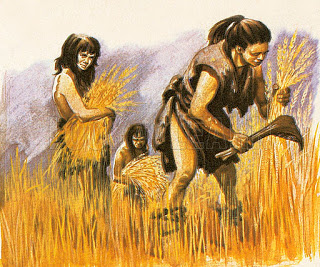
Agriculture is estimated to have popped up around 10,000 years ago, synonymous with the end of the last major ice age and a new era, known as the Holocene epoch (our current epoch!).This era has been marked by the ever-increasing development of human technology and ingenuity, and agriculture has been no exception! But what actually is agriculture? How and why did it begin? And what impact has it had on the environment over time?

Just in case you’re not quite clued up about agriculture, I’ll start us off with a formal definition… According to the Oxford English Dictionary, agriculture is “the science or practice of farming, including cultivation of the soil for the growing of crops and the rearing of animals to provide food, wool, and other products”. So, in a NUTshell, agriculture exists to feed us, clothe us and medicate us (amongst a million other things) through the process of farming, with the two main divisions of agriculture being livestock farming and crop production.

This concept of agriculture seems pretty routine these days, but how did we come up with it in the first place? What techniques did we use? And what caused us to transition from hunter gatherers to farmers?

                Source: https://lygsbtd.files.wordpress.com/                       Source: https://o.quizlet.com/

For many years, early man relied on sustenance from fruits, nuts and megafauna, like mammoths, until their untimely extinction approximately 15,000 years ago, when humans turned to hunting smaller game (look at last post for more details!!!). After which, came another period of intense global cooling, known as the Younger Dryas, which saw ice returning and woodland decreasing, leaving food to become more scarce for the next few thousand years…

Once the climate recovered from these tundra conditions, it appeared that agriculture arose not long after. However, its reason for rearing its head is still a topic of wide debate. One hypothesis claims that the warm weather succeeding the Younger Dryas caused a “baby boom” = more mouths to feed! This increase in demand is thought have forced us to seek more sustainable food sources, such as the domestication of animals and cultivation of plants. Although, it’s still not definitively known whether agriculture was a response to an increasing population, or whether an increasing population was product of booming agriculture. In this latter instance, opinion is divided between the idea that agriculture was a response to intense hunger, or was discovered through the experimentation of farming.

To open the debate even WIDER, some believe that origins of agriculture stem from a single, intelligent individual whose idea spread rapidly as an improvement beyond foraging (agricultural revolution), whilst others believe that civilisations used their knowledge of plants and the land to accompany foraging with agriculture, as a back-up plan when hunting was not so fruitful (agricultural evolution). Regardless of how, agriculture was happening, and was beginning to consume the Earth…

Map to illustrate believed first sites of agriculture. Source: www.life.illinois.edu/

Crop cultivation and selective breeding were some of the earliest agricultural practices. Examples of this include: cereals in Syria (c.7000BC), seedless fruits from fig trees in Jordan (c.9300BC), rice fields in China, cultivation of squash in Mexico (c.8000BC), and corn in North America some years later (approx. 3000BC). Alongside this, the domestication of animals (that we still most commonly eat today!) began approximately 10,000 years ago. This can be seen in the DNA of Europeans, especially...  Many of our ancestors were initially unable to tolerate cow’s milk, however, genetic mutations leading to lactose tolerance occurred through natural selection due to prevalence of cow herding in Europe, allowing a large proportion of us to drink milk today. Evolution in front of our very eyes!

However, you can’t make an omelette with breaking some eggs… This method of cultivating plants caused an increasing genetic uniformity, allowing them to become more susceptible to pathogens and disease (with species competition transitioning from interspecific to intraspecific). The same story was said for domesticated animals: their predictability created an environment that allowed contagious diseases to thrive. This began the race between man and contagion (an issue still very much prevalent in today’s world), giving rise to the pesticide!


Additionally to disease, evidence shows that this new age of agriculture may have had a huge impact on our climate, with an estimated global temperature increase of 1.5°F!! Large-scale burning and up-rooting of forests, to allow room for farming, led to vast releases of carbon dioxide (the most notable greenhouse gas) into the atmosphere, causing a global warming. However, the removal of forests would have likely made the surface of the Earth brighter and more reflective (known as “albedo”), causing sunlight to bounce off of the surface more often, resulting in a cooling effect. Although, deforestation can also cause a shift in micro-climate, which has serious impacts on food production and food security over time. We truly were meddling beings!!


Our effect on the environment has been obvious (yet completely surprising!) through the ages… Join me next time to see how we’re continuing the trend in today’s world, and what that means for the future of global food production…


Saturday, 24 October 2015

Global Food Insecurity

Welcome back to the Global Hot Potato! For the first few weeks of our blogging journey, we will be looking specifically at one side of the coin: how food production practices impact the environment. So make sure you strap in, as we will be exploring a combination of research, articles, reports, and environmental models to measure past/present impacts and predict future events. But, before we delve into the gritty details of the food production industry, we should first take a brief look at the current challenges we face today when it comes to feeding the planet.

To adequately address these challenges, we must first consider what it means to be without them, i.e. food security. In 2002, the UN’s Food and Agricultural Organisation defined food security to be “a situation that exists when all people, at all times, have physical, social and economic access to sufficient, safe and nutritious food that meets their dietary needs and food preferences for an active and healthy life”.[1]  We know through the prevalence of poverty across the globe that this has not yet been achieved. But why? Are there too many of us? Is there not enough food? What’s going on here?

A growing population has a massive impact on global food insecurity. Although it is hard to predict the potential carrying capacity of the Earth, the World Food Programme states that there is enough food produced globally to feed the entire population, which was last measured to be nearing 7.4 billion people. Yet, despite this, an estimated 793 million people live undernourished and in food poverty. Although there has been a decline since 1990-92 (Fig.1), that's still a whopping 10% of the world population!!! But, if there isn’t a global shortage of food, then why are there so many people living in food poverty?

Fig. 1: a comparison between the proportion and location of people in food poverty in 1990-1992 and 2014-2016

The World Health Organisation considers there to be three cornerstones affecting food security: access, availability and use.
  • Limited access to food can be largely attributed to increased poverty, where individuals do not possess the resources necessary to obtain sufficient nourishment. This was a particular topic on concern in 2008, when food prices reached an all-time high, seeing many people with decreased access to healthy, nutritious food across all parts of the planet. However, in today's world, approximately 98% of the malnourished population are living in less economically developed regions (Fig.1), showing us that the economy plays a huge role in global food security. 

  • One of the biggest factors influencing the availability of food is climate change. Certain regions are experiencing increased drought, flooding and unprecedented natural disasters, which is having a major impact on our ability to grow certain food in affected areas and decreasing potential yield. Not to mention that food production itself is contributing  largely to climate change, creating a unsustainable cycle of food insecurity (but I will get into that more later).

  • The way food is used can refer to the knowledge and care for our food, (e.g. understanding nutrition and food hygiene). It can also refer to what we actually DO with our food. Did you know that one third of all food produced is thrown away? ONE THIRD!?!?! What?!?! We destroy landscapes, produce tonnes of greenhouse emissions and waste precious water to produce our food just to throw ONE THIRD of it all away?!!! I can't help but find that truly horrifying…


It seems clear that our current methods of food production are unsustainable. With an increasing population projected to reach 9.6 billion by 2050, how do we intend to cope with this increasing demand sustainably, without irreparably damaging the Earth, and without leaving millions in food poverty? Before we can even begin to contemplate this huge question, we will need to take a look at what current food production practices are being utilised across the global and evaluate the environmental and social impacts these practices have. We will then consider the role modelling has in measuring these impacts and predicting the future. In my next post, I will starting by focusing on the industrial livestock production: past, present and future.

Follow me on Twitter@chlobular for extra snippets regarding food production and climate change!


[1] FAO. 2002. The State of Food Insecurity in the World 2001. Rome.