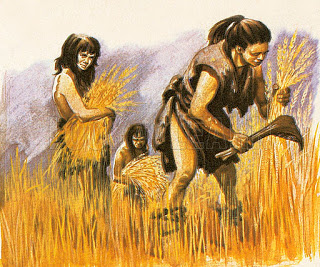
Agriculture is estimated to have popped up around 10,000
years ago, synonymous with the end of the last major ice age and a new era, known
as the Holocene epoch (our current epoch!).This era has been marked by
the ever-increasing development of human technology and ingenuity, and
agriculture has been no exception! But what actually is agriculture? How and
why did it begin? And what impact has it had on the environment over time?
Just in case you’re not quite clued up about agriculture,
I’ll start us off with a formal definition… According to the Oxford English Dictionary, agriculture is “the science or practice of farming, including
cultivation of the soil for the growing of crops and the rearing of animals to
provide food, wool, and other products”. So, in a NUTshell, agriculture exists
to feed us, clothe us and medicate us (amongst a million other things) through
the process of farming, with the two main divisions of agriculture being livestock
farming and crop production.
This concept of agriculture seems pretty routine these days, but how did we come up with it in the first place? What techniques did we use? And what caused us to transition from hunter gatherers to farmers?

Source: https://lygsbtd.files.wordpress.com/ Source: https://o.quizlet.com/
For many years, early man relied on sustenance from fruits,
nuts and megafauna, like mammoths, until their untimely extinction approximately
15,000 years ago, when humans turned to hunting smaller game (look at
last post for more details!!!). After which, came another period of
intense global cooling, known as the Younger Dryas, which saw ice
returning and woodland decreasing, leaving food to become more scarce for the
next few thousand years…
Once the climate recovered from these tundra conditions, it appeared
that agriculture arose not long after. However, its reason for rearing its head
is still a topic of wide debate. One hypothesis claims that the warm weather
succeeding the Younger Dryas caused a “baby boom” = more mouths to feed! This
increase in demand is thought have forced us to seek more sustainable food
sources, such as the domestication of animals and cultivation of plants. Although,
it’s still not definitively known whether agriculture was a response to an
increasing population, or whether an increasing population was product of
booming agriculture. In this latter instance, opinion is divided between the
idea that agriculture was a response to intense hunger, or was discovered
through the experimentation of farming.
To open the debate even WIDER, some believe that origins of agriculture
stem from a single, intelligent individual whose idea spread rapidly as
an improvement beyond foraging (agricultural revolution), whilst others believe
that civilisations used their knowledge of plants and the land to accompany
foraging with agriculture, as a back-up plan when hunting was not so fruitful
(agricultural evolution). Regardless of how, agriculture was happening,
and was beginning to consume the Earth…

Map to illustrate believed first sites of agriculture. Source: www.life.illinois.edu/
Crop cultivation and selective breeding were some of
the earliest agricultural practices. Examples of this include: cereals in Syria
(c.7000BC), seedless fruits from fig trees in Jordan (c.9300BC), rice fields in
China, cultivation of squash in Mexico (c.8000BC), and corn in North America
some years later (approx. 3000BC). Alongside this, the domestication of animals
(that we still most commonly eat today!) began approximately 10,000 years ago.
This can be seen in the DNA of Europeans, especially... Many of our ancestors were initially unable
to tolerate cow’s milk, however, genetic mutations leading to lactose tolerance
occurred through natural selection due to prevalence of cow herding in
Europe, allowing a large proportion of us to drink milk today. Evolution in front
of our very eyes!
However, you can’t make an omelette with breaking some eggs…
This method of cultivating plants caused an increasing genetic uniformity, allowing
them to become more susceptible to pathogens and disease (with species
competition transitioning from interspecific to intraspecific).
The same story was said for domesticated animals: their predictability created
an environment that allowed contagious diseases to thrive. This began the race
between man and contagion (an issue still very much prevalent in today’s world),
giving rise to the pesticide!

Additionally to disease, evidence shows that this new age of
agriculture may have had a huge impact on our climate, with an estimated global
temperature increase of 1.5°F!! Large-scale burning and up-rooting of
forests, to allow room for farming, led to vast releases of carbon dioxide (the
most notable greenhouse gas) into the atmosphere, causing a global warming. However,
the removal of forests would have likely made the surface of the Earth brighter
and more reflective (known as “albedo”), causing sunlight to bounce off
of the surface more often, resulting in a cooling effect. Although,
deforestation can also cause a shift in micro-climate, which has serious
impacts on food production and food security over time. We truly were
meddling beings!!
Our effect on the environment has been obvious (yet
completely surprising!) through the ages… Join me next time to see how we’re
continuing the trend in today’s world, and what that means for the future of global food production…