Showing posts with label livestock. Show all posts

Monday, 28 December 2015

Open Your Eyes: Sustainable Agriculture

Over the last few weeks, we have explored the largely damaging impacts of industrial agriculture, characterised by the exploitation of resources, large-scale single specie regimes, and high consumption of fossil fuels, pesticides and fertilisers. The destruction of this farming methodology is undeniable, from the emissions, pollution and deforestation of the livestock industry to the water depletion, desertification and toxic chemicals produced by crop production. This cannot go on indefinitely. But what can we do? Surely there are no other options?

Wrong! Sustainable agriculture is an alternative which, in its various practices, involves fulfilling present and future demands of food, water, health and ecosystem demands, whilst maximising societal benefits and environmental well-being. These systems typically focus on conserving resources, utilising natural ecosystem relationships between animals and plants, preserving biodiversity, reducing chemical inputs and incorporating renewable forms of energy. Additionally, sustainable agriculture tends to bring the consumer closer to the producer by decreasing the size of farms, distance travelled and emphasis on economic gains (that inevitably push hidden costs onto society), and in the long term sustaining healthy soil, land, communities and ecosystems.

What makes this type of agricultural more beneficial? In a world where resources and economic expansion are limited, we need to move away from our desire to drive profits, and push toward a more secure future. Sustainable agriculture tends to rely on small-scale, independent and local farms, which generate local employment, local spending and boost average incomes. Unsurprisingly, agribusinesses and farming industries are shown to do the opposite, with the core aim to turn high yields and profits at the expense of farmers, communities and the environment. These big businesses can actually be highly inefficient/ For example, despite rice farmers in Japan, Korea and Taiwan using more than 50% of all insecticides sprayed on rice globally, they yield only 2% of the Earth’s crops.

So, if sustainable agriculture benefits consumers, producers and the environment, why aren’t we doing it? Maybe the techniques used are hard to achieve? Wrong again! Here are some examples of the typical methods used by sustainable farmers:
  • Rotation of two or more crops – to reduce pests, increase biodiversity and soil fertility
  • Improved soil management –  by decreasing chemical inputs, and increasing organic material suitable for helpful bacteria and fungi
  • Maintaining topsoil – by reducing the use of heavy machinery on the soil, this is known as tillage
  • Allowing animals to graze rotationally – by relocating animals to different fields to improve soil quality, restore vegetation, and reduce high-protein feed, need for manure management and costs.
  • Nitrogen management – by decreasing use of high-protein feeds, fertilisers and pesticides, farmers can effectively monitor nutrient content in soil and prevent contamination of waterways and air quality.

I don't know about you guys, but this was always my idea of how normal farms operated (until discovering the reality and widespread existence of factory farms), and I ascertain that that is how they should be! So, what do we need to do to push for more of these systems?! 
  1. Raise awareness of the importance and social benefits of sustainable agriculture
  2. Campaign for climate and social justice in the agricultural sector
  3. Make sensible dietary choices that eliminate industrial means, i.e. opt for local, seasonal and organic produce
  4. Put press on industrial farms by holding them accountable!
  5. Reduce animal products, particularly from caged animals

Source: http://s.hswstatic.com


Sunday, 29 November 2015

Livestock Production: Part 3 – A Modeller’s Perspective

It’s never easy explaining to anybody what you do at university, regardless of what you study. When I studied Mathematics for my bachelor's degree, people would always ask what that entailed, and would then proceed to get incredibly confused or uninterested when I tried to explain. This has lessened since studying Environmental Modelling, probably because the environment is something that almost all of us can identify with, or at least respect its importance (except maybe Donald Trump and the Tories). However, I still get asked the same question all the time: “what actually is environmental modelling?”

Source: http://memecrunch.com/
A model, in general, is a simulation of a real-life system for the purpose of understanding that system better. For example, you can use models to forecast future behaviour (without having to wait for time to unfold), and develop projections based on changes in the system (without having to tamper with the real-life system). However, to do this first requires assumptions about our system (parameters), boundary and initial conditions, and an understanding of the model and inter-connected relationships within it. Then, we can construct a model using field observation, laboratory experiments, mathematical equations, statistics, logic, and computation to best predict the system in the simplest way necessary.
In an environmental modelling context, these systems are highly variable. The whole Earth as a system is used for many different models, such as weather forecasting, fluctuations in sea surface temperatures and climate change. Alternatively, some models can focus on specific localised regions, like ecological models/population dynamics, hydrological systems, etc. We can even use models to simulate livestock systems!

But, why should we do that? Well, instead of using trial and error on the parameters of the model to increase productivity or predict environmental damage, models allow us to use computers, which is more cost-effective, faster and can avoid unnecessary environmental damage. However, predicting systems is incredibly difficult, which can sometimes make environmental models fairly unreliable. To avoid them going pear-shaped, we need to highlight the most vital parameters in our model and portray them as accurately as possible.


Source: http://www.cliparthut.com/

Here are some examples of livestock production models:

Global Livestock Environmental Assessment Model (GLEAM)

This model, produced by the FAO, does exactly what it says on the tin: assesses the environmental impacts of global livestock production, which include greenhouse gas emissions, land use, land degradation and forestry, feed, water use and species interaction, as well as determine possible adaptation and mitigation strategies on a regional and global scale.

The main elements of the model are as follows:
  • Systematic, global coverage of meat and milk from cattle, sheep, goat and buffalo, meat and eggs from chicken, and meat from pigs.
  • Spatial distribution models of livestock, climate data and feed yields to identify driving factors, environmental consequences and mitigation strategies
  • Approximations of carbon dioxide, methane and nitrous oxide (GHG emissions) at each stage of production, and from fermentation and manure management

The outputs of the model are:
  • ·    Spatial distribution and quantity of cattle, sheep, goats, buffaloes, chickens and pigs
  •      Amount and management of manure
  •      Volume, composition and quality of feed
  •      Emissions emitted at each stage of production
  •      Commodities produced by livestock

Integrated Model to Assess the Global Environment (IMAGE)

This model has been developed by the PBL Netherlands Environmental Assessment Agency to measure the environmental impacts of global human activity, including livestock production systems. This aspect of IMAGE is similar to GLEAM as it measures the impact of livestock production on greenhouse gas emissions, air and water pollutants, and land use.

European Livestock Policy Evaluation Network (ELPEN)

The purpose of ELPEN is to measure or predict the outcomes of policy change in the livestock industry. The model incorporates bio-geographical data (including climate, land cover, soil, water, topography), statistical data, economic, social, environmental and technical features of livestock systems, to produce conclusions based on social, economic and environmental effects of policy change.

Livestock Development Planning System, Version 2 (LDPS2)

The LDPS2 is a computer model to aid livestock development planners in decision-making for livestock systems, including those of cattle, sheep, goats, buffaloes, pigs and poultry.

The main features are:
  • Calculating the size, composition and feed of livestock herds needed for a given demand of livestock products, including meat, milk, eggs, skin, wool, manure and power supply
  • Measuring the growth of herds to find the “growth constraint” to meet demand
  • Compares these estimates with the amount of resources available

Source: http://images.all-free-download.com/

Sunday, 15 November 2015

Livestock Production: Part 1 - Facts, Figures & Ethical Considerations

With all the background information we have gathered over the last few weeks, we can finally kick-start the review of modern food production practices, by looking at the global impacts of intensive livestock farming. I must stress that I have tried hard to look at the evidence with unbiased eyes, ditching any preconceptions I may have previously held. However, this is, admittedly, no piece of cake! We’ve all heard horror stories of the factory farming industry, and the internet does not fail to keep them coming, by hosting a wide inventory of sensationalist articles, videos and pictures that will put you off meat for good... Well, until you’ve miraculously forgotten about it a few minutes later… (Guilty!) So, to avoid being misinformed, I have largely structured my reading on scientific papers, research and well-cited articles, whilst still considering some element of opinion from credible organisations, albeit with a pinch of salt.


Now let’s start with the bare facts. This year, the Food and Agriculture Organisation (FAO) estimated the global average meat consumption to be 41.30kg per capita, with the average consumption in industrial countries (e.g. European countries, USA and Australia) to be 2.32 times this figure, roughly equivalent to 262g of meat per person per day. For comparisons sake, this is equates to eating about 9 rashers of bacon, or 3-4 sausages, or 2⅓ quarter-pounder burgers each day. However, if we revisit the FAO’s figures we see that, since 1964/66, the average consumption in industrial countries have increased by a factor of 1.56, whereas in developing countries this is a factor of 3.10! Despite this, western countries still devour a heck of a lot more meat than developed countries, by over threefold!


                                      MEEEEEEAT! Source: www.willowbrookorganic.org/


Why is this an issue? What’s so bad about meat? Despite the recent connection found between cancer and processed/red meat, in moderation, meat can contribute as part of a healthy, balanced diet, providing protein, minerals (e.g. iron) and vitamins (e.g. B12). Yet, with plenty of other non-animal sources of these essential nutrients, the question stands: are we consuming and producing more meat than necessary? Current estimates suggest that livestock production is responsible for approximately 14.5% of global Anthropogenic greenhouse gas emissions (FAO, 2013). Shockingly, 61% of these emissions were generated by cattle alone via both the meat and dairy industries, whilst poultry (incl. meat and eggs) and piggies only generate 8% and 9% respectively… So, what’s going on here? Where are all these emissions coming from? Before we look at the environmental implications, we must first consider the current methods of practice that put the meat on our plates.

I’m not sure about you, but when I think of meat production, my thoughts immediately turn to factory farming, characterised by large numbers of animals crammed into restricted space and requiring substantial quantities of food, water and antibiotics. This comes as no surprise as, globally, factory farming contributes to about 72% of poultry production, 43% of egg production, and 55% of pork production, with suggestions that figures for cattle are slightly lower (although this is not conclusive). These percentages are pretty high, but are honestly a bit lower than I anticipated! Saying that, in countries like the USA these figures are generally greater than 90%, with exception to cattle with approximately 78% raised from factory farms, which probably explains my initial perception of the situation.


   Sources: Image 1: www.an1mal.org/ , Image 2: http://allergiesandyourgut.com/ , Image 3: www.fairwarning.org

Regardless, intensive livestock farming is the dominant method of meat and dairy production in the world, and continuously raises ethical concerns for animal welfare, such as, the confinement to metal cages to restrict movement, reduced (or lack of) access to fresh air and natural light, and removal of tails and beaks to reduce loss of livestock through aggressive behaviour (most likely due to heightened tensions caused by poor living conditions). Additionally, the desire to boost productivity of the end “product” which can cause adverse effects, for example, increased growth rates of chickens leads to higher risk of lameness, increased egg yield in laying hens can lead to osteoporosis, and greater number of offspring can lead to higher infant mortality. Not to forget concerns over human welfare… With large agribusinesses on the rise, small farmers are on the decline, as some are unable to compete with these vast, industrial practices at the same low cost.To some, this may seem like fair game, but this produces a net decline of labour force, thus resulting in less available jobs.

Most of this is probably nothing new to you. We all know this stuff, to a degree, and since it’s incredibly easy to detach yourself from the reality, it becomes very easy to ignore. You don’t often see the industrial process. You can’t truly measure an animal's emotional response. Plus, meat is so readily available, it doesn’t take a second thought. However, the environmental implications are a lot harder to ignore, or at least will be as time goes on. Deforestation, greenhouse gas emissions, water source contamination… The list is endless! Yet, a lot of us still aren’t that clued up about the full extent of the impacts in an environmental context. So, instead of shying away, join me for part 2, as I explore the major impacts that meat production is having on our planet, and how we can predict the future effects using modelling.

Don’t forget to follow me on twitter for more updates on food production and climate change: @chlobular

Saturday, 7 November 2015

The Dawn of Agriculture

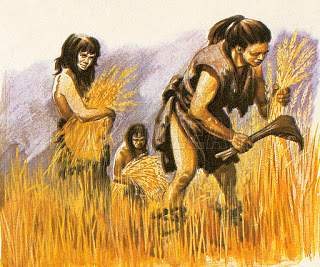
Agriculture is estimated to have popped up around 10,000 years ago, synonymous with the end of the last major ice age and a new era, known as the Holocene epoch (our current epoch!).This era has been marked by the ever-increasing development of human technology and ingenuity, and agriculture has been no exception! But what actually is agriculture? How and why did it begin? And what impact has it had on the environment over time?

Just in case you’re not quite clued up about agriculture, I’ll start us off with a formal definition… According to the Oxford English Dictionary, agriculture is “the science or practice of farming, including cultivation of the soil for the growing of crops and the rearing of animals to provide food, wool, and other products”. So, in a NUTshell, agriculture exists to feed us, clothe us and medicate us (amongst a million other things) through the process of farming, with the two main divisions of agriculture being livestock farming and crop production.

This concept of agriculture seems pretty routine these days, but how did we come up with it in the first place? What techniques did we use? And what caused us to transition from hunter gatherers to farmers?

                Source: https://lygsbtd.files.wordpress.com/                       Source: https://o.quizlet.com/

For many years, early man relied on sustenance from fruits, nuts and megafauna, like mammoths, until their untimely extinction approximately 15,000 years ago, when humans turned to hunting smaller game (look at last post for more details!!!). After which, came another period of intense global cooling, known as the Younger Dryas, which saw ice returning and woodland decreasing, leaving food to become more scarce for the next few thousand years…

Once the climate recovered from these tundra conditions, it appeared that agriculture arose not long after. However, its reason for rearing its head is still a topic of wide debate. One hypothesis claims that the warm weather succeeding the Younger Dryas caused a “baby boom” = more mouths to feed! This increase in demand is thought have forced us to seek more sustainable food sources, such as the domestication of animals and cultivation of plants. Although, it’s still not definitively known whether agriculture was a response to an increasing population, or whether an increasing population was product of booming agriculture. In this latter instance, opinion is divided between the idea that agriculture was a response to intense hunger, or was discovered through the experimentation of farming.

To open the debate even WIDER, some believe that origins of agriculture stem from a single, intelligent individual whose idea spread rapidly as an improvement beyond foraging (agricultural revolution), whilst others believe that civilisations used their knowledge of plants and the land to accompany foraging with agriculture, as a back-up plan when hunting was not so fruitful (agricultural evolution). Regardless of how, agriculture was happening, and was beginning to consume the Earth…

Map to illustrate believed first sites of agriculture. Source: www.life.illinois.edu/

Crop cultivation and selective breeding were some of the earliest agricultural practices. Examples of this include: cereals in Syria (c.7000BC), seedless fruits from fig trees in Jordan (c.9300BC), rice fields in China, cultivation of squash in Mexico (c.8000BC), and corn in North America some years later (approx. 3000BC). Alongside this, the domestication of animals (that we still most commonly eat today!) began approximately 10,000 years ago. This can be seen in the DNA of Europeans, especially...  Many of our ancestors were initially unable to tolerate cow’s milk, however, genetic mutations leading to lactose tolerance occurred through natural selection due to prevalence of cow herding in Europe, allowing a large proportion of us to drink milk today. Evolution in front of our very eyes!

However, you can’t make an omelette with breaking some eggs… This method of cultivating plants caused an increasing genetic uniformity, allowing them to become more susceptible to pathogens and disease (with species competition transitioning from interspecific to intraspecific). The same story was said for domesticated animals: their predictability created an environment that allowed contagious diseases to thrive. This began the race between man and contagion (an issue still very much prevalent in today’s world), giving rise to the pesticide!


Additionally to disease, evidence shows that this new age of agriculture may have had a huge impact on our climate, with an estimated global temperature increase of 1.5°F!! Large-scale burning and up-rooting of forests, to allow room for farming, led to vast releases of carbon dioxide (the most notable greenhouse gas) into the atmosphere, causing a global warming. However, the removal of forests would have likely made the surface of the Earth brighter and more reflective (known as “albedo”), causing sunlight to bounce off of the surface more often, resulting in a cooling effect. Although, deforestation can also cause a shift in micro-climate, which has serious impacts on food production and food security over time. We truly were meddling beings!!


Our effect on the environment has been obvious (yet completely surprising!) through the ages… Join me next time to see how we’re continuing the trend in today’s world, and what that means for the future of global food production…